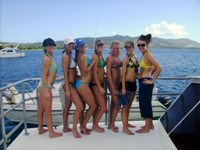




Karleen, Angela, Jen and Rosie are enjoying their time at the beach (located across GTDS Main Office). They had run out there by crossing the Marine Drive during a busy traffic (not a good idea but FUN). They got so tired of staring from their office window and watching the local people having a great time, especially the ones on the Jet Ski. So out of no where they decided to join in the fun after work.
Going to the beach is really relaxing and refreshing especially from a long day at work. You should one day stop by and join in the fun with the GTDS Girls. Only next time, they promise to bring swimming wear.

GTDS main shop has moved to a new location.
TO the NEW SHOP we GO!!!!!
Physical Address: AC Building 646 E. Marine Dr.
East Hagatna, GU 96910 (right next door to the Mobil Cooperate Office and Mobil Gas Station).
Store phone: 648-4837 and Fax: 647-2775
Operation Hours are still the same: 07:30am-18:00
Right now, we’re in the process of making improvements. Please stop by and our friendly staff will show you around.
Map to the NEW PLACE:
View GTDS New Location in a larger map

Spring season is in full force, everywhere the green is deepening, and the Summer days are around the corner, along with the summer showers, water temperatures are continuing to hover in the 80’s (28-29celcius). What is it with Guam waters, when is it going to cool off? We’re so wanting to break out the dry suits. Maybe if it gets down to 27 celcius???
The boat schedule is on the website !!
Check out the schedule for end of this month, and a new schedule will be out soon for May. Check it out, and join us.
Equipment News - -
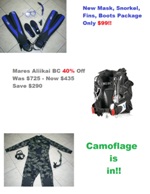
We’ve got all this new stuff: awesome buoyancy devices, dive tools (knives) in all shapes sizes, both steel and titanium. And lots of the little goodies that make whatever diving you’re doing, fun and convenient.
Salt Water Ugly:
Caring for your gear: is everyone truly rinsing their equipment after every dive? How about actually soaking it? Post dive rinsing is very important, but it is only the first step in protecting your gear from the impacts of saltwater. Soaking your gear in fresh water, should be added to your regimen. If you want to do a quick evaluation of potential salt corrosion, go to the regulator, pull back the hose protectors that are on the hoses up close to the first stage, if there is corrosion, then it’s probably a good time to take your reg in for servicing. If you’ve been doing a good job at rinsing, and soaking, there should be no, to little, discoloration underneath the hose protectors.
Looking for when’s the best time to dive? Any day, as there are boats on the dive sites daily.
But what is our best kept secret? GTDS has a wonderful Divemaster/Guide who is leading free shore dives every weekend. His name is Barry (we call him Bear, because he’s the kind of gentleman you want on your side in a dark alley). Barry loves taking folks to out of the way dive sites, ones that are visited only infrequently. In fact, most of the sites he visits, are really only known by ‘locals’. So if you’re looking for new adventures, and having that professional, as well as local expertise, to guide you along, seek out Bear (I mean Barry), and enjoy some of the best dives available from Guam’s shores.
We’re here for you, every day of the year -
So give us a call at GTDS, we can not only take you out diving on any day of the year, we can offer you the certification course you need, any day of the year too.

Now that we’re into January, have you been into the waters yet? Awesome viz has returned. Outside the harbor, we’re seeing minimum 18-20meters (60-70ft) every day. And not sure, but is it possible that the waters can get any warmer? I can attest that at 200’+ (60m+), the temperatures are still in the 80’s (29celcius).
The boat schedule is on the website !!
Check out the schedule for the second half of January. And join us.
Equipment Care - -
Not sure how you do it, but we’ve seen lots of divers who at the end of the dive trip, use the high pressure air from the tank in an attempt to dry the 1st stage intake. Actually, this is the wrong thing to do. And unfortunately, there are some instructors out there who teach it this way. Using high pressure air to ‘dry’ the intake can actually drive residual ocean water into the inner chamber of the first stage, and then the salt begins to corrode the inside of the regulator. Additionally, using high pressure air can actually be harmful to the hearing of anyone around.
The proper steps for stowing your regulator are these: 1. Use a dry cloth (towel) to wipe dry the first stage intake orifice. 2. Use the dry cloth to dry off the dust/moisture cover. 3. Place the dust/moisture cover into position and tighten down, finger tight. 4. Gently coil your regulator’s hoses, so that there are no severe bends or kinks. 5. Stow in your gear bag in such a way as to protect the regulator from external impact.
Looking for when’s the best time to dive? Tide Charts for 2010 are here :-)
We have free tide charts in our downtown dive center across from ACE Hardware. Quite nice they are the regular wall calendar style, with the tides graphically illustrated for every day of each month. So stop by have a chat, and pick one up.
Want to join the Elite of diving ? Becoming an Instructor ?
We’ve got three different scheduled formats available to meet your needs. The first option is a four consecutive weekend schedule. The second option is two long weekends: 4 day weekend (Thur-Sun) and a 3 day weekend (Fri-Sun). The third option is an intensive 7 day program: Mon-Sun.
The dates for the three options are:
4 Consecutive Weekends: March 6th-7th, March 13th-14th, March 20th-21st, March 27th-28th.
2 Long Weekends: March 11th – 14th (Thursday-Sunday), and March 26th-28th (Fri-Sunday)
1 Week Intensive: March 22nd - March 28th (Monday – Sunday)
The Instructor Examination is scheduled for Wednesday and Thursday, March 31st, and April 1st.
These three options include the complete 2010 Instructor Development Curriculum. Also, included in the schedule is the EFR Instructor course. Prior to the Instructor Examination, on Monday and Tuesday March 29th-30th we will be offering specialty instructor training, for candidates who want to begin offering specialties straight away.
We’re here for you, every day of the year -
So give us a call at GTDS, we can not only take you out diving on any day of the year, we can offer you the certification course you need, any day of the year too.

Holiday time is upon us, and with it the dry season has arrived. Yes we still have the occasional early morning showers, but the days are dry, and the seas are calm.
Great Weather is here !!
That means we are headed into the best diving of the year. Already visibility has increased to the point that on most days you can see the Blue Hole from the surface. That’s a good 18m/60’ of viz. Fantastic. The waters are warm, as usual. And they’ll be getting warmer. So if anybody has let their dive gear dry out, this is definitely the time start getting wet again.
Get your Dive Equipment ready - -
If it has been awhile since you’ve been in the water, it would be a good idea to drop your regulators off for their yearly servicing. Getting your yearly service, keeps the regulators in warranty, and that’s important.
If you have your own tanks, the valves do need servicing too. So when you take them in for the annual Visual inspection, make sure you’re asking for valve service, especially if you can’t remember when they were last serviced.
Last thought on servicing, you might want to have the technician check out your BCD, the dump valves have an o-ring that needs to be inspected. It’s not something that needs replacement every year. But it should be checked.
The dry season with its calm waters, soft breezes, makes for awesome diving both inside the harbor and outside. That means really every weekend, and every dive site is likely to be a great dive.
Looking out for the Pelagics :-)
Recently, the Blue Hole has been host to a juvenile white tip shark. He or she, (haven’t gotten close enough to see which) is a little over 2 meters long, and has been seen several times over the past couple of weeks. While we’re often looking for the small stuff, like nudibranchs, one should take those occasional glances around, especially scanning the open blue, for the larger aquatic life, that prefers to keep its distance from divers.
Taking your next step down the dive training Ladder @ GTDS
If you are fairly new to diving, or you’ve been just the occasional diver, it would do your dive life a lot of good to consider doing either your Advanced Open Water Diver or Enriched Air Diver certifications. Both of these certifications will add a lot to your diving.
Advanced Open Water Diver
Advanced will improve your skills and knowledge to handle deeper dives (up to 30m/100’) and navigation, along with three other areas of diving. Other areas of diving to sample during your Advanced class include: Drift Diving, Digital Photography, Night Diving, Wreck Diving, Naturalist, Search and Recovery, Buoyancy, Videography, just to name a few.
That gas they call Nitrox
Enriched Air, better known as Nitrox, will provide you with the knowledge and credential needed to get the most from every dive and every dive trip. Because diving with Nitrox will allow you extend your bottom times, and, or, shorten your surface intervals.
For example, if you dive on air, and go to depths around 26m/86’ your no-decompression limit(NDL) is 27 minutes. However if you are diving with 32% enriched air, then your NDL is 40 minutes. Or even better, if you are diving 36% enriched air, your NDL is a whopping 50 minutes.
If you’ve been diving with your Open Water Diver cert, and that’s all, is it not time to consider expanding your dive options? Advanced Open Water Diver, and Enriched Air Diver both, are incredibly valuable certs, and the great part? You can take them separately or together, up to you.
We’re here for you, every day of the year -
So give us a call at GTDS, we can not only take you out diving on any day of the year, we can offer you the certification course you need, any day of the year too.